One Earth, one Dream—one transformational journey across songlines and timelines
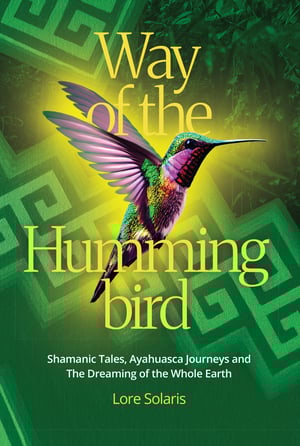
Way of the Hummingbird
Shamanic Tales, Ayahuasca Journeys and the Dreaming of the Whole Earth
⭐⭐⭐⭐⭐ 5 star rated on Amazon
by Lore Solaris
DreamingArts Publishing
690 pages | paperback and ebook

An in-depth analysis of Way of the Hummingbird
Few books in the psychedelic genre come anywhere close to this level of cultural literacy and lived authenticity.
Way of the Hummingbird is an expansive, mature and fiercely heartfelt work that sits at the crossroads of memoir, anthropology, spiritual literature and cultural testimony. It is the story of a man walking between worlds — between Country and modern society, trauma and revelation, persecution and prophecy — and emerging with shamanic movement that speaks not only to personal healing, but to the deep evolutionary longing of a world in crisis.
From its opening pages, the book establishes itself as a rare accomplishment in contemporary nonfiction: a narrative told with poetic clarity and emotional honesty, yet informed by decades of lived ceremonial practice, cross-cultural immersion, and a sophisticated understanding of Indigenous cosmologies. The voice is grounded and human, yet capable of rising into visionary, symbolic and mythic registers without losing integrity or coherence. There is no spiritual posturing here; instead, the reader encounters a writer who has walked through fire — literal and metaphorical — and writes from the place where lived experience, humility and spiritual depth meet.
Structure and narrative arc
The narrative structure moves in sweeping arcs. We begin with the raw terrain of childhood — a landscape marked by trauma, chaos and ancestral wounding — and watch the emergence of a seeker, a musician, a healer in formation. The book then carries us into the heart of Brazil and the Amazon, where apprenticeship becomes initiation, and initiation becomes full-bodied transformation. These chapters are rich with ethnographic texture: detailed observations of Santo Daime, Umbanda, and Indigenous ceremonial life; nuanced portrayals of spiritual teachers; shimmering descriptions of mirações, hymns, songlines and plant intelligences. Readers unfamiliar with these worlds find themselves gently inducted into them; readers who know them intimately will recognise the accuracy and respect with which they are rendered.
The Amazonian chapters
In its middle section, the book expands into something even deeper: an account of Amazonian life and cosmology that is rare in its precision and beauty. Lore’s extended chapters with the Huni Kuin — including his canoe journeys deep into uncontacted border regions, his formal naming, musical transmission, and his participation in sacred communal life — read like a contemporary classic of participatory anthropology. They offer a kind of inside-out ethnography: experiential, relational, initiatory, and still written with clarity that honours the cultures involved. Few books in the psychedelic genre come anywhere close to this level of cultural literacy and lived authenticity.
Grief, scrutiny and the limits of institutions
As the narrative progresses, the tone shifts again — this time into the terrain of social crisis, political scrutiny, and personal catastrophe. The chapter describing the tragedy in the Australian community, the coronial aftermath, the media distortions and the machinery of institutional persecution, stands as one of the most emotionally gripping and politically relevant sections of the entire manuscript. It is written without bitterness or self-justification. Instead, it reveals a man trying to speak truthfully from the inside of a storm, navigating grief, injustice, fear, and an entire bureaucratic apparatus incapable of understanding the spiritual, cultural and psychological worlds in which he works. The chapter achieves the near-impossible: it grants the reader a visceral sense of the moral complexity of contemporary spiritual leadership, while also exposing the fragility of modern institutions when faced with anything that challenges their worldview.
Closing movements and the Afterword
The final movements of the book are luminous. The Afterword — a fireside yarn with Uncle BJ — grounds the entire manuscript in Country, lore and the living philosophy of First Nations wisdom. It is a blessing, a reckoning and a cultural anchor point. With this, the book closes not with self-exaltation, but with humility, relationality and the voice of an Elder who situates the entire journey inside the wider Dreaming of this land.
Themes
What sets Way of the Hummingbird apart is its breadth. It is intimate memoir, yes — but also ethnography, cosmology, musical theology, ecological philosophy, cross-cultural diplomacy and political critique. It speaks to trauma and healing, but also to ceremony, community leadership, Indigenous sovereignty, ecological collapse, the psychedelic renaissance, and the reawakening of the human spirit. It is a book written not merely for individuals on a spiritual path, but for an entire culture wrestling with disconnection, fragmentation and the hunger for meaning.
The writing
Literarily, the writing is strong, atmospheric, emotionally intelligent and enriched with poetic cadence. There is a musicality to the prose that reflects the author’s own training as a ceremonial musician — paragraphs rise and fall like hymns; visions unfold in sequences of colour and sound; the voice carries both lyricism and technical acuity. The glossary at the end of the book, meanwhile, elevates the work into scholarly territory, offering one of the most precise and culturally respectful cross-lineage spiritual glossaries available in contemporary literature.
" I highly recommend Way of the Hummingbird to anyone seeking a deeper understanding of sacred medicines, spiritual insight, or simply a curisoity about the visionary world that lies beyond" - Amazon reviewer
Who this book is for
Readers who love non-fiction adventure and mystery will love Way of the Hummingbird. The journey unfolds with twists ad turns what will surprise and delight. For spiritual seekers and those interested in Australian and Amazonian shamanism and spirituality this book is a treasure trove of lived experience and indigenous wisdom shared from the heart. Those new to the Ayahuasca path this is possibly one of the best guide books available. For the experienced practitioner it is full of easter eggs of insights, tips and techniques to deepen your own skills, knowledge and practice of Ayahuasca and visionary shamanism.
What to expect as a reader
The writing is easy to read, professionally edited, with clear language expressing at times complex concepts. The first part of the book is background knowledge and setting the scene for the shamanic world and the world of Ayahuasca looking at the Dreaming stories, ancestry and modern adaptations. The next two parts of the book are a flow of first person stories and accounts of real shamanic journeys, teachings, cultural references and personal memoir. It is an easy and fast paced read. Readers report not being able to put it down and it will keep you intrigued as each chapter progresses. There is an extensive glossary that you can use as the book goes along or as a stand-alone reference guide for those on the path.
What this book doesn't do
This book is not a sales pitch for Ayahuasca or it is not designed to convince you of anything. These are deeply personal accounts of a lived path by a significant contributor to the modern Dreaming of Ayahuasca and contemporary spiritual practice. The book shows the shadow sides as well as the light.
This book has all the qualities of a breakthrough work — not only for its beauty and depth, but for its timing. At a moment when the world is facing unprecedented crises of mental health, ecological collapse, spiritual hunger and political polarisation, Way of the Hummingbird offers a narrative that is both sobering and hopeful. It shows the wounds of society honestly, yet offers a vision of healing rooted in real ceremonial practice, Indigenous principles, and a mature spiritual intelligence.
Conclusion: why this book matters
Way of the Hummingbird is not just a memoir. It is a bridge — between worlds, between cultures, between epochs.
It holds the vulnerability of a personal story, the precision of ethnography, the fire of spiritual testimony, and the clarity of political and ecological conscience. It is a book written directly from lived experience, yet speaking into the universal questions of our time:
- How do we heal?
- How do we return to the Earth?
- How do we navigate persecution with grace?
- How do we hold ceremony in a world losing its memory of the sacred?
-How do we dream a new world into being?
It is the kind of work that travels across continents, across disciplines, and across generations.